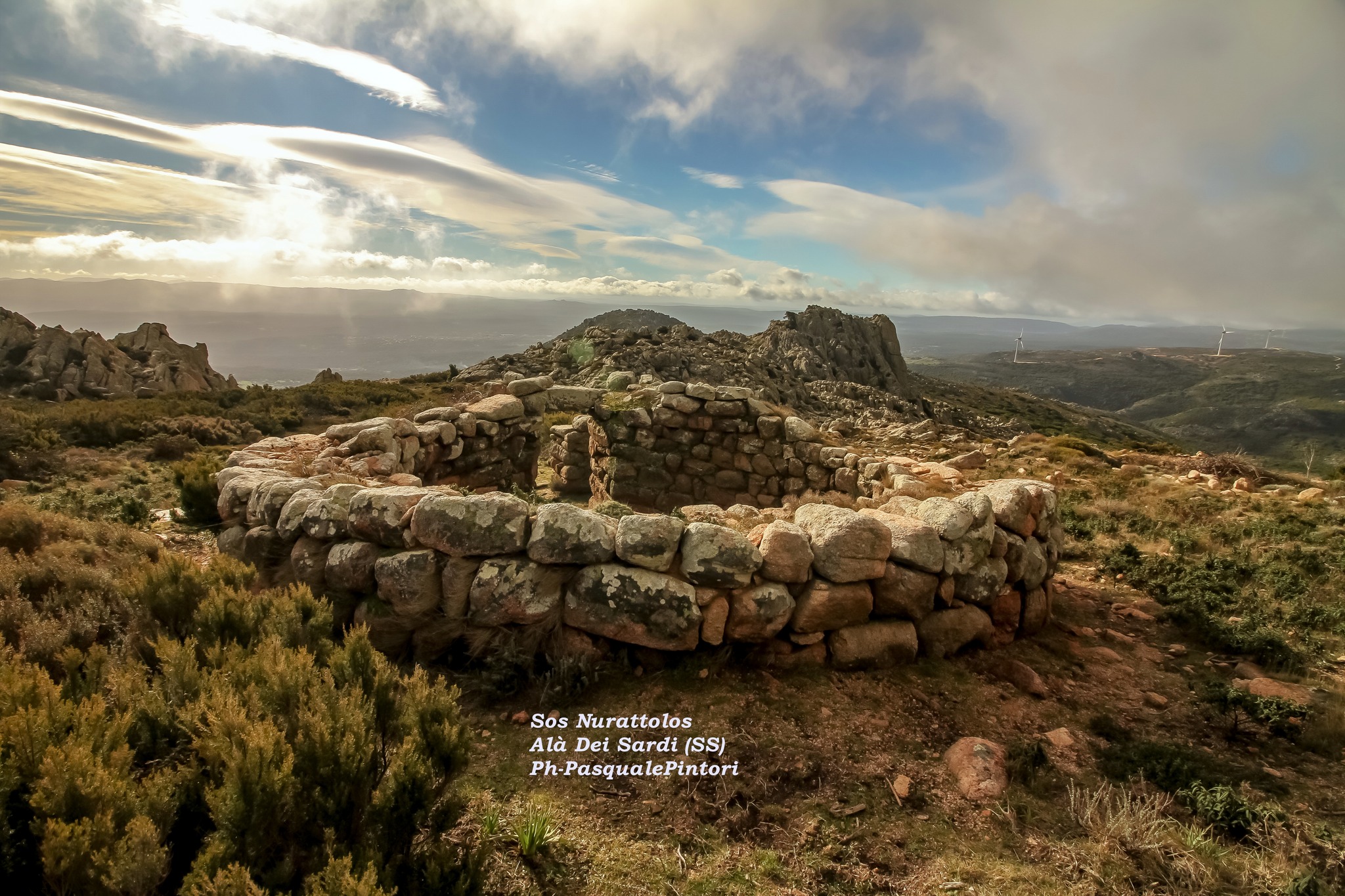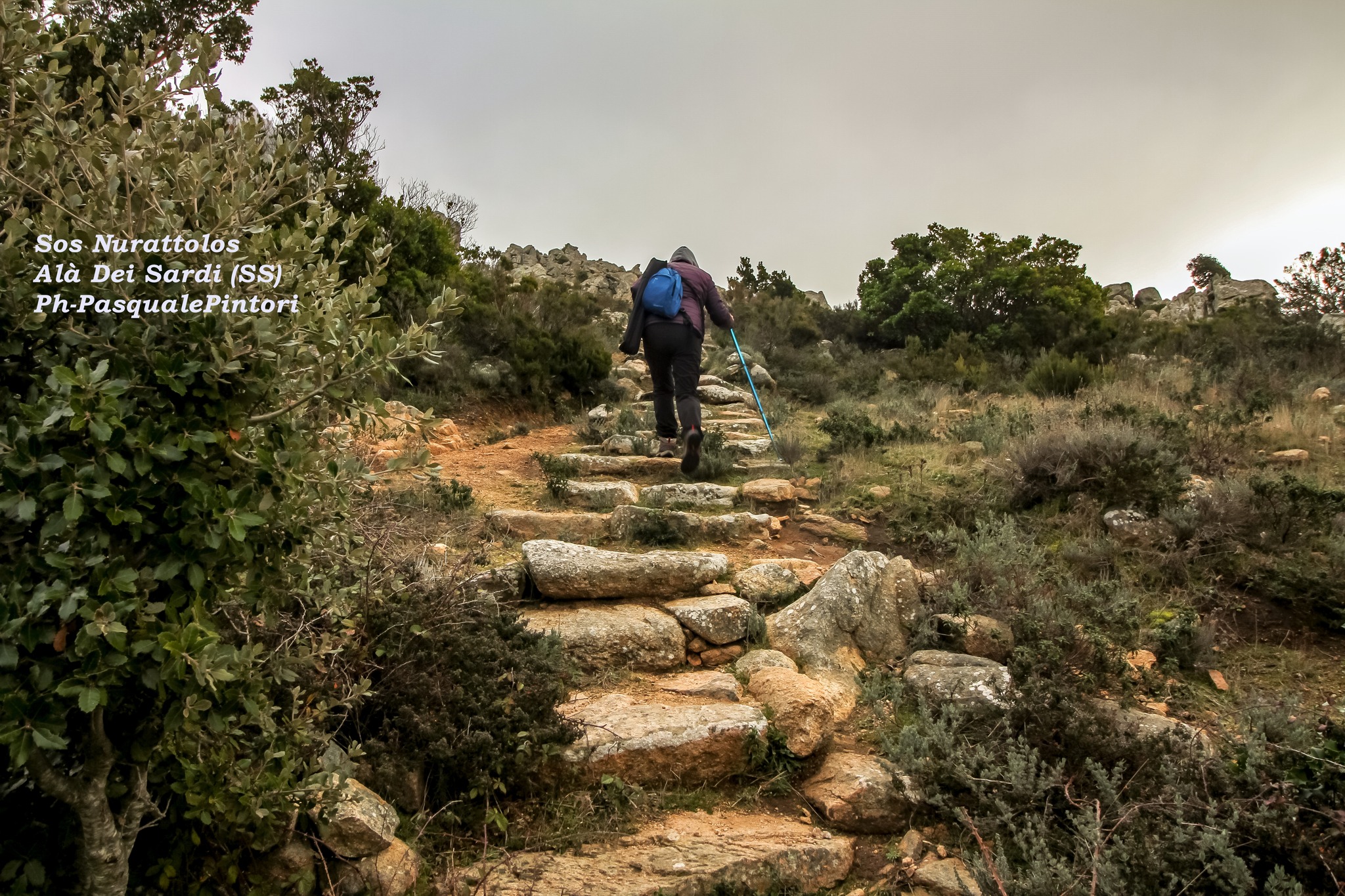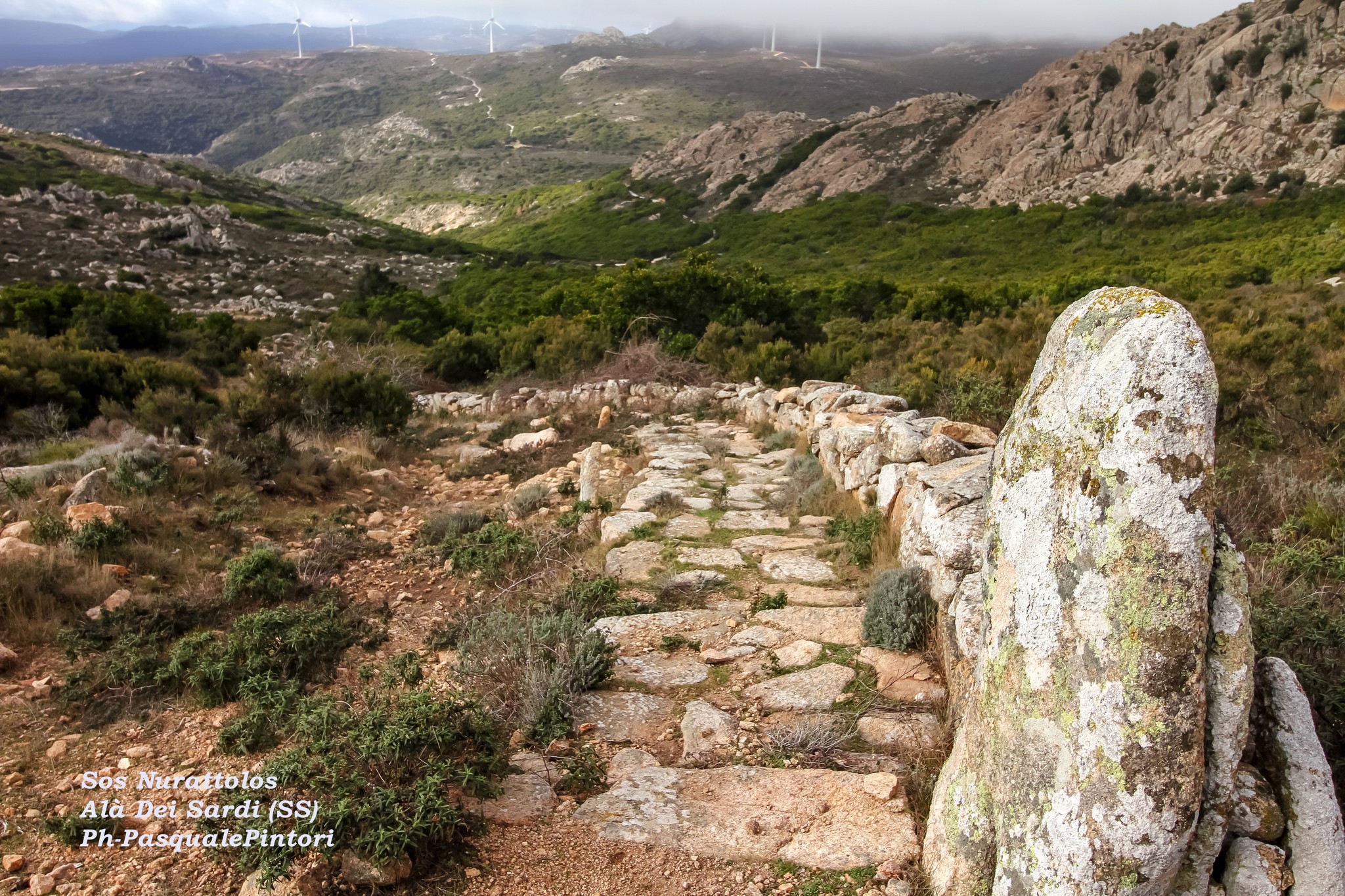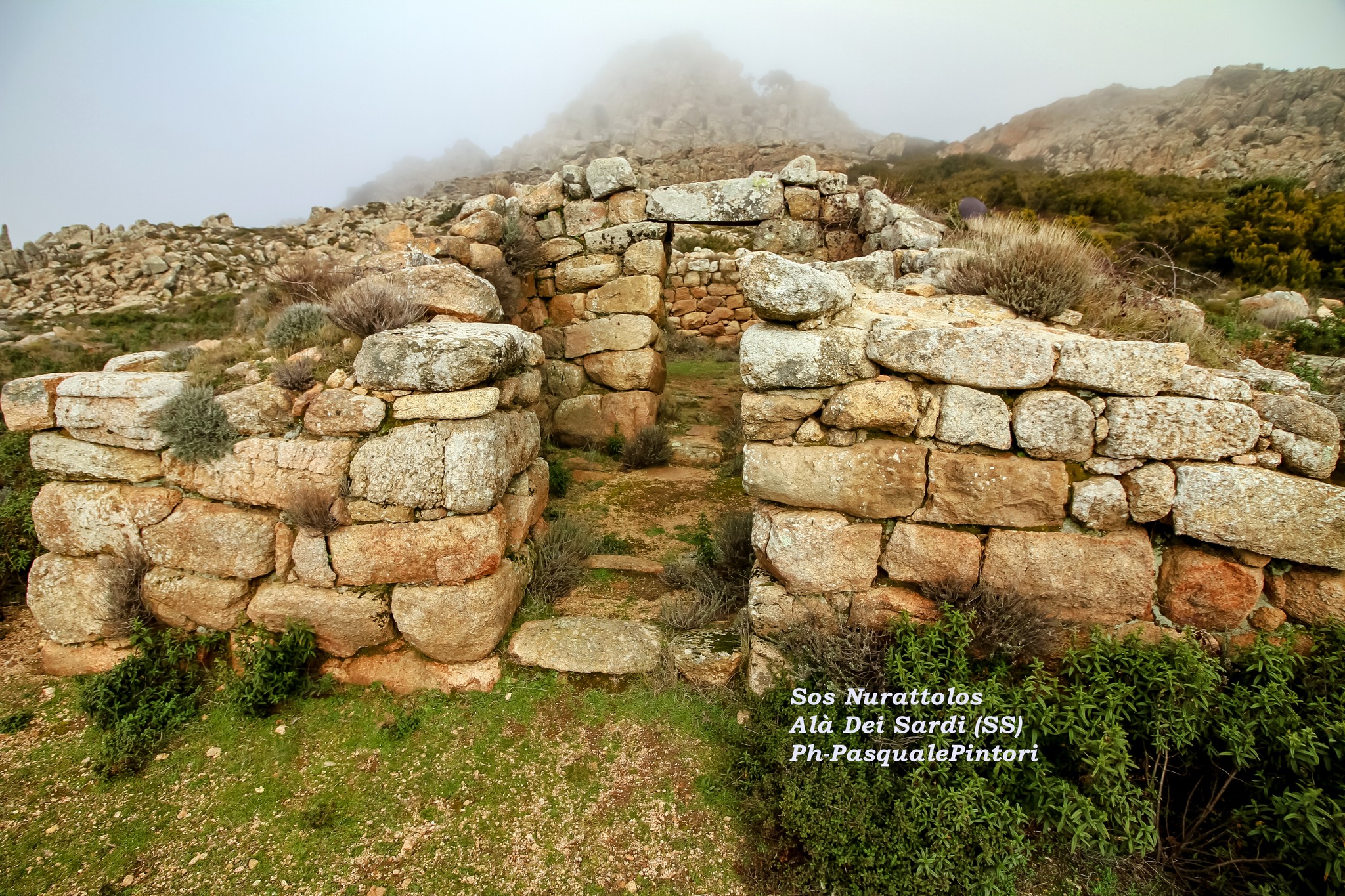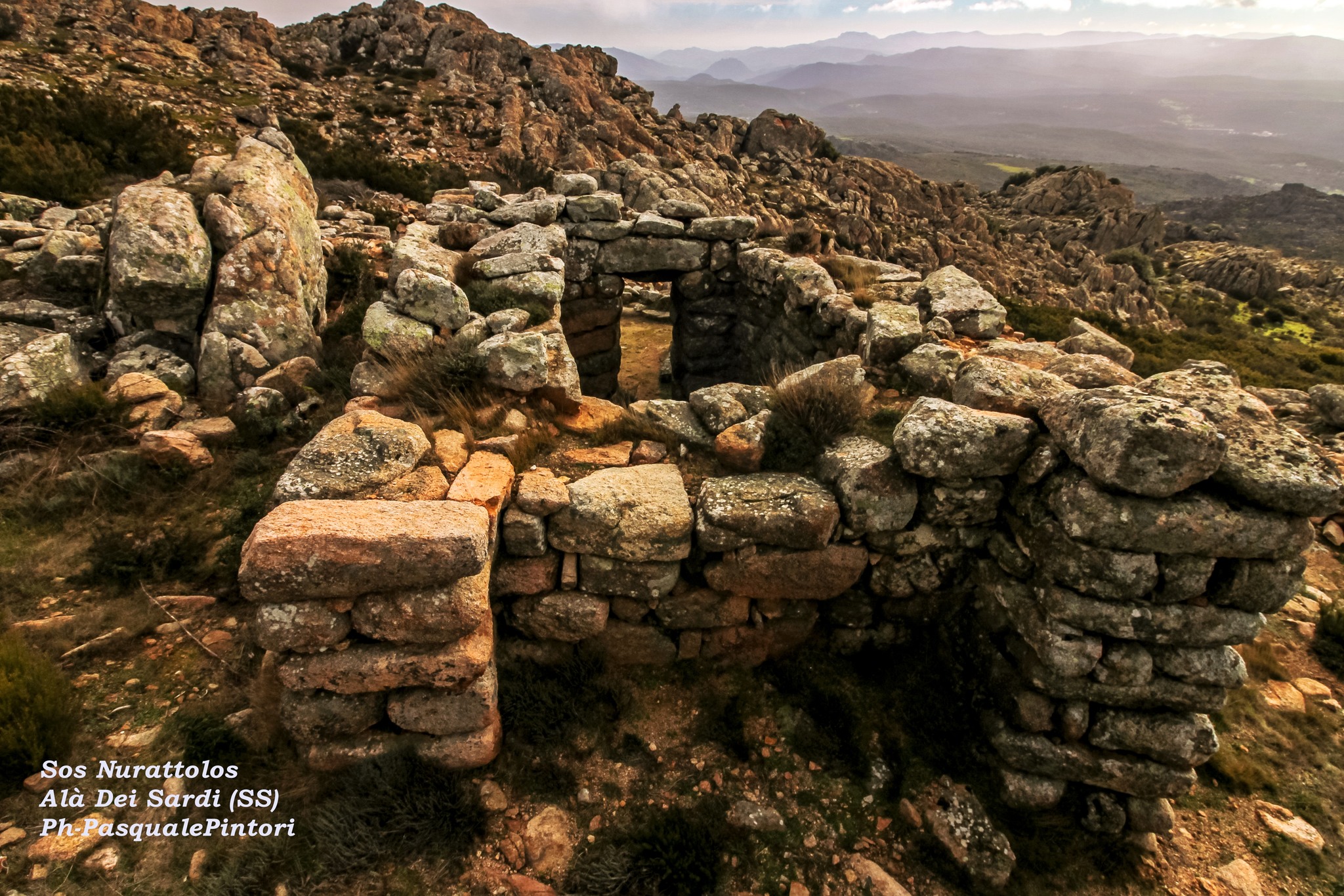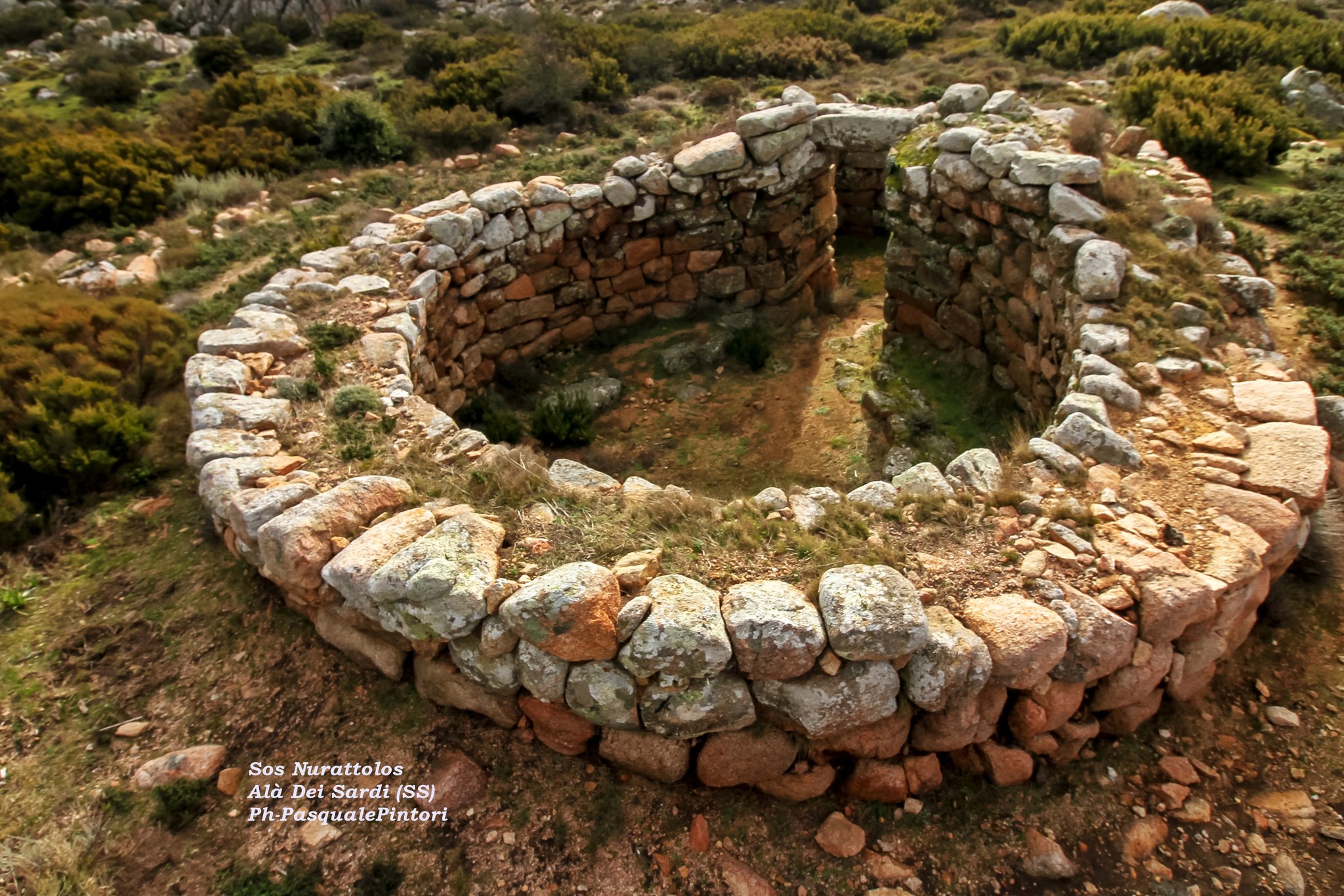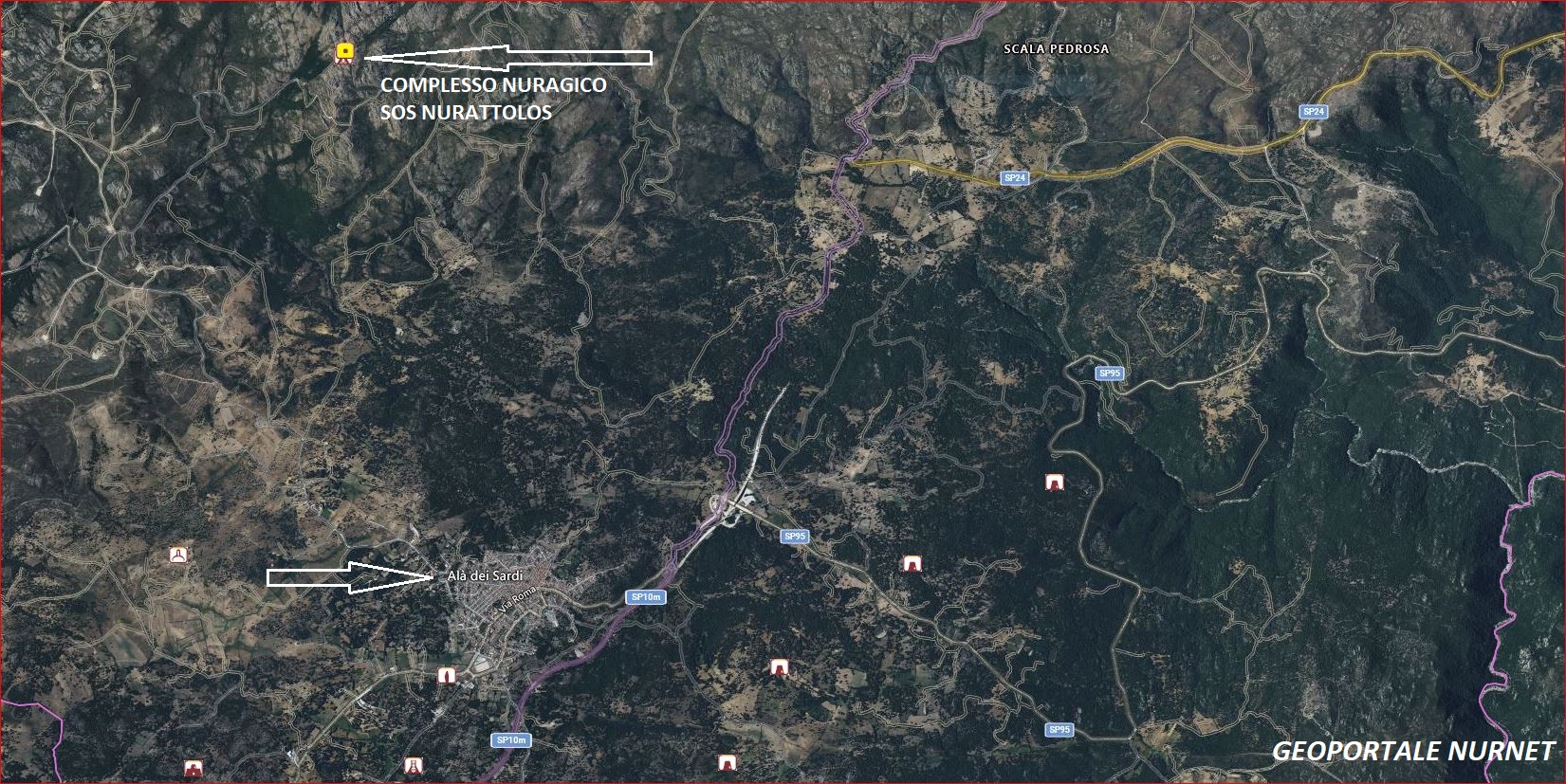
The complex of Sos Nurattolos (Alà dei Sardi) rises at the foot of Punta Senalonga, in a dominant position over the Buddusò plateau and the surrounding valleys. The site includes a sacred spring, a small ‘megaron’ temple – both with an enclosure – and some huts, one of which is attached to the temple.
Climbing the slope towards the top of the rise, one encounters the fountain, consisting of a body with a circular plan (diameter 6.25 m) built with large boulders arranged in polygonal work in the outer face and with square blocks in the inner structures. The building encloses a rectangular vestibule (length 5 m; width 2.60 m; height 90 cm), accessible through a south-facing entrance (width 70 cm). In the centre of the back wall opens the architraved entrance, with a drainage compartment, of the quadrangular cell with an ogival section that protects the spring vein. This small chamber has a stepped roof descending towards the arched bottom; the masonry is made of medium-sized granite boulders, arranged in regular rows with the use of wedges.
The building is surrounded by the usual circular sacred enclosure (11.30 m NE-SW; 10.00 m SE-NW), built in polygonal work (0.70/1.20 m thick) and accessible through a side entrance (1.10 m wide) facing south and equipped with steps.
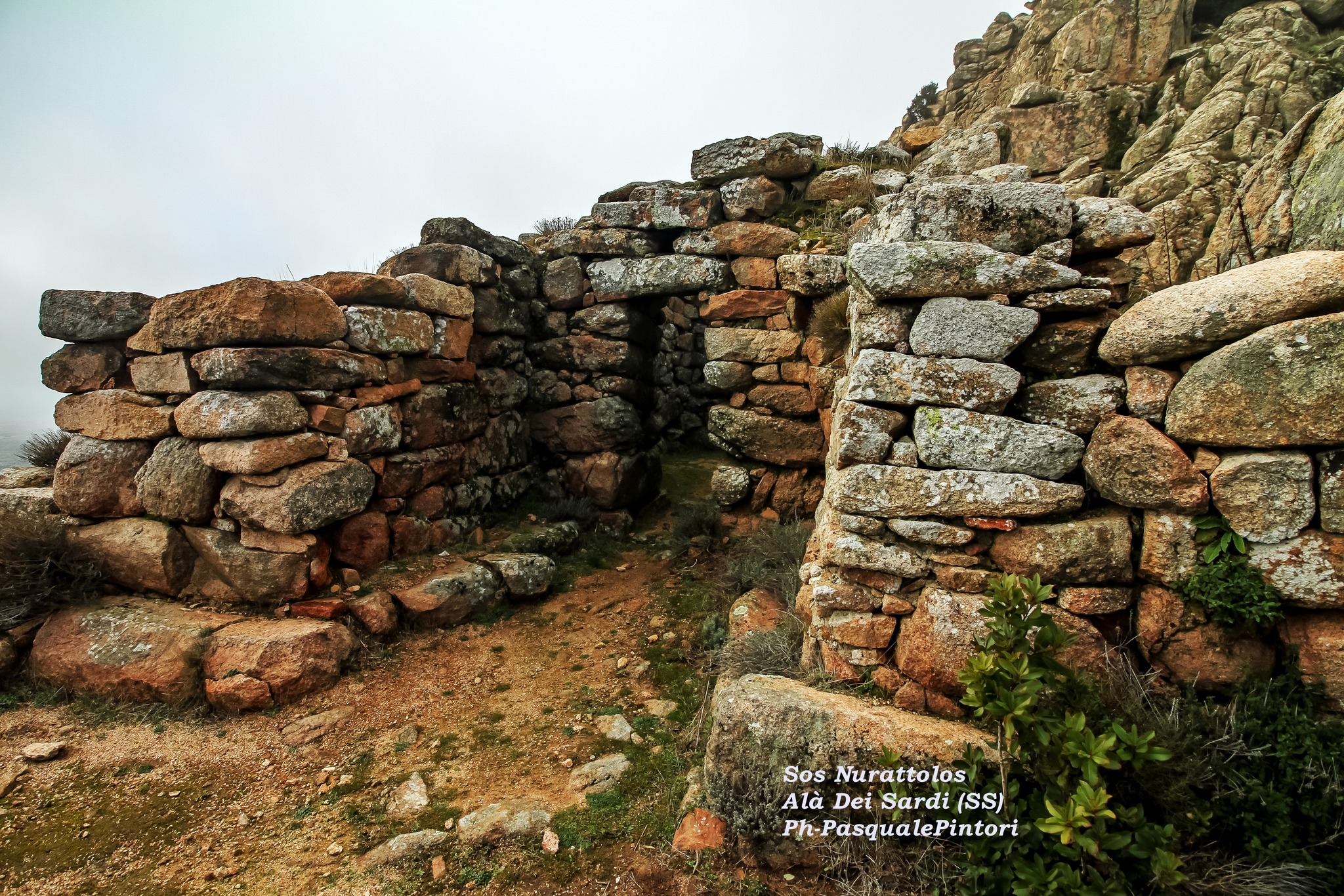
Not far from the pit, a large circular hut is built (internal diameter 8.40 m; thickness 1.40 m) with an architraved entrance facing south-east (width 0.80 m). The structure is made of small stones that are generally unworked and stacked without particular care.On top of the rise is the small rectangular ‘megaron’ temple, whose wall structures are still preserved to a considerable height. The building is built within an elliptical enclosure (diameter 16 x 13 m) with an east-facing entrance (width 0.90 m). The construction – built with granite boulders arranged in regular rows – has a rectangular plan (6.15 x 4 m; h. 2 m) with an architraved entrance facing north-west (w. 0.90 m; h. 1.20 m). The small temple is characterised by the presence of the typical extension of the side walls at the back. Inside, the walls do not show a notable projection; it is assumed that the structures originally supported a double-sloping wooden roof.
Next to the small temple, there is a singular construction: a circular building (diameter 5.20 m; h. 1 m) that encloses a second room of the same shape (diameter 2.30 m), tangent to the south-east side and with walls with a considerable projection. The two constructions do not appear to have entrances.
A short distance away, at a higher elevation, excavation work has uncovered a new, large hut with a communal character. Its walls have a seat at the base, similar to what is documented in the so-called ‘meeting huts’ found in numerous Nuragic villages.
Source: Sardegna Cultura.
The photos of the Sos Nurattolos nuragic complex are by Pasquale Pintori.